

• Skip to main content
  • Skip to header right navigation
  • Skip to site footer
Project Ketchum

Project Ketchum

City of Ketchum

  • Home
  • City of Ketchum
  • Stay in the Loop

Phase 3 Code Updates

What’s being changed?

After adopting the 2025 Comprehensive Plan and the consolidated Land Development Code (i.e. Cohesive Ketchum phases 1 and 2, click here to find out more), Ketchum is launching Cohesive Ketchum phase 3 which will amend the city’s land use regulations to implement the goals and policies of the updated Comprehensive Plan. The project is being lead by staff and a code consultant, Goebel Partners.

Phase 3 code updates will happen in three installments. Each installment is expected to take about one year to complete. City Council and the Planning and Zoning Commission have set priorities for the code changes in each installment; four main topics are being addressed in installment 1.

    Downtown

    Downtown is the heart and soul of Ketchum. The Comprehensive Plan provides goals and policies that are intended to cultivate a vibrant downtown environment that celebrates Ketchum’s history and character while balancing the needs of residents, businesses, and visitors. The policy direction in the Comprehensive Plan encourages reinforcing the history and defining characteristics of downtown, supports the creation and retention of local businesses, and promotes enhancing multi-modal connections to and within downtown.

    Downtown dimensional standards and zoning regulations will be evaluated by the staff and the consultant. Regulations to be evaluated include:

    • Lot and Building Standards – Evaluation of use allowances, lot size, FAR requirements, ground-floor setback, upper-floor setbacks, and building heights.
    • FAR Density Bonus Program – Evaluation of additional community benefits to receive bonus density, and percentage of increased gross floor area that is community housing.
    • Design Standards – Consideration of design standards or guidelines that encourage creativity and innovation, promote infill and redevelopment that is responsive to the surrounding neighborhood or district context, and provide a menu of options to achieve compatibility.

    Local Business Support

    The Comprehensive Plan includes numerous policies aimed at propping up the local economy by fostering a climate supportive of existing independent businesses as well as the creation and retention of new ones. The plan highlights the importance of recognizing and promoting local businesses that have operated in Ketchum for an extended period of time and have contributed to our history. To advance these goals, the project consultant team will evaluate the availability of affordable commercial space in the downtown area. Based on the analysis, recommendations will be provided on the potential design of any code regulations. Any programmatic support measures that fall outside of the code update will be undertaken through a separate project.

    Parking

    One of the core values in the Comprehensive Plan is a connected transportation network. Within this value policies recognize the need of coordinated planning for parking management, shared parking, and parking inventory. Crucial in analyzing these topics is an evaluation of off-street parking and how that facilitates efficient movement through the community by supporting residential and commercial uses alike.

    The citywide off-street parking requirements will be reviewed and updated by staff and the consultant. Regulations to be evaluated are:

    • Residential Parking – An evaluation of minimum off-street parking ratios for new development based on best practice research from Idaho, other peer communities, and national data.
    • Parking Exemptions – Evaluation of current parking exemptions, including whether to continue or modify such exemptions, and whether additional exemptions should be considered.

    While the above topics are the main focus, parking alternatives, bicycle parking, and design/landscape of parking areas will also be looked at.

    Mountain Overlay

    The Comprehensive Plan calls for the protection and enhancement of our mountainous views and other natural features. Hillsides in Ketchum will continue to be protected from future development by refining our Mountain Overlay District standards which guide the development on hillside lots.

    Staff will lead an update of several elements of the current standards including:

    • Building Height – An evaluation of the current height allowance and definition to reduce visual impact of structures within the Mountain Overlay.
    • Lot Coverage – An evaluation of how lot coverage allowance and how lot coverage is calculated on large lots in the Mountain Overlay to reduce the area disturbed by new development.
    • Clustered Development – Encouraging clustered development at lower elevations to reduce the amount of grading and excavation required and preserve the views and natural features of the hillsides.
    • Minimize Construction Impacts – Minimizing construction impacts through a more detailed set of standards that address streets, excavation, grading, and other site- or lot-based concerns.

    Nonconformities

    The Comprehensive Plan calls out Ketchum’s eclectic character and elevates its distinctive built environment and vibrant downtown as core values. After growing organically over time, through annexations and differing land use regulations, many of Ketchum’s existing buildings do not meet the current requirements and may not meet future requirements. Those buildings are called “nonconforming”. Decreasing barriers to the reuse of our existing buildings will support preservation of Ketchum’s eclectic character and will be a benefit to constituents’ personal and communal property. To facilitate the reuse of nonconforming structures, instead of demolition and redevelopment, the city needs to make special rules to allow for their continued use.

    Staff will lead an update to the regulations including:

    • Nonconforming Buildings – Evaluation of how much a property owner can do to a nonconforming building and what the process is for approving changes.
    • Low vs High Impact Nonconformities – Not all nonconformities have negative effects on adjacent properties or the City as a whole. Staff will be exploring changes that provide greater leniency on low impact items while maintaining regulations that benefit the community.

    In addition to buildings, the city also has nonconforming lots and uses. Nonconforming lots are already addressed to allow for development. Nonconforming uses will be addressed throughout the process with changes to each zone district.

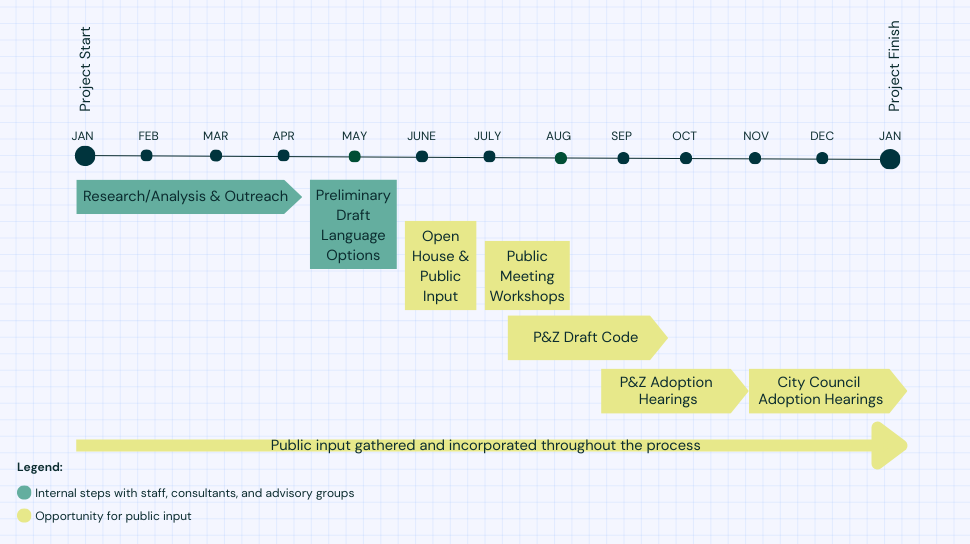
    Timeline for Installment 1

    Installments 1, 2, and 3 are tentatively scheduled for 2026, 2027, and 2028 respectively. Topics for each installment were set by the Planning and Zoning Commission and City Council, who staff will continue to take direction from as the project continues. As such, topics and timelines may be subject to change.

    The below time line is expected for Installment 1.

    Get Involved

    Opportunities for community and stakeholder input will be provided throughout Phase 3 Code Updates.

    Upcoming Events

    • Planning staff is deep in research and analysis. Stay tuned for our first outreach events!

    Past Events

    City Meetings
    • Joint Meeting: P&Z Commission and City Council (linked here)

    Technical Advisory Group

    In addition to the various opportunities for community and stakeholder engagement, the project team is supported by the Technical Advisory Group. The Technical Advisory Group, which was established by the city in 2023, provides strategic input and guidance on community design and development issues.

    Architecture Representatives
    • Mike Doty, Michael Doty Associates
    • Gretchen Wagner, Scape Design Studio
    • Jolyon Sawrey, Vital Ink Environmental Architecture
    • Nicole Ramey, Medici Architects
    • Hunter Todd, RLB Architecture
    • Darshan Amrit, Architect
    Landscape Architecture Representative
    • Kurt Eggers, Eggers Associates
    Engineering Representatives
    • Alex Nelson, PE, Alpine Enterprises Inc
    • Matt Smithman, PE, Starhope Engineering
    • Dave Patrie, Galena-Benchmark Associates
    Contractor Representative
    • Tim Carter, Idaho Mountain Builders
    Developer Representatives
    • Reid Sanborn, Engel & Volkers Sun Valley 
    • Dave Wilson, Wilson Construction
    • Peter Seidner, Presidio Vista Properties
    Trade Association Representatives
    • Mel Jackson, Sun Valley Economic Development
    • Ned Burns, Sun Valley Board of Realtors
    Planning Representatives
    • Susan Passovoy
    • Dennis Scholl
    Historic Preservation Commission Representative
    • Jakub Galczynski, Historic Preservation Commissioner
    Ketchum Business Representative
    • Bill Griffin

    FAQ

    What topics are slated for installments 2 and 3?

    Installments 2 and 3 are tentatively scheduled for 2027 and 2028 respectively. Topics for each installment were set by the Planning and Zoning Commission and City Council, who staff will continue to take direction from as the project continues. As such, topics and timelines may be subject to change.

    Installment 2 topics include the review and update of:

    • Residential districts & other zoning districts to reinforce key policy directions
    • Use regulations to eliminate antiquated uses, consolidate like uses, create new uses, and ensure use type definitions are clear
    • Development standards for design review and landscaping.
    • Floodplain
    • Administration and Procedures
    • Environmental protections

    Installment 3 topics include the review and update of:

    • Light Industrial Districts, Mixed-Use Activity Centers, and Overlay Districts
    • Dark Sky regulations
    • Signs
    • Conditional Use Permits
    • Rules of Construction
    • Definitions
    What is the role of land use regulations?

    The Land Development Code establishes the regulations and standards for land use and development within the City of Ketchum. i.e. how land is legally established, what is able to get built on that land, and what uses are allowed on that land. Ketchum’s recently adopted Land Development Code (the “Code”) consolidated the City’s Zoning Ordinance, Subdivision Regulations, and Right-of-Way Standards (Title’s 17, 16, & 12) with no substantial changes. Cohesive Ketchum Phase 3 Code Updates will delve into specific topics to analyze substantial changes that bring the Code into conformance with the 2025 Comprehensive Plan. Title 15 (building and construction standards) also intersects with the Land Development Code but is not currently under the scope of the project.

    Why update land use regulations now?

    Idaho statutes mandate that every city has both a Comprehensive Plan (to establish a vision and policy framework) and a zoning ordinance (to regulate the built environment and implement the provisions of the Comprehensive Plan). Ketchum’s existing zoning and subdivision ordinances were developed and adopted in the 1970s and have experienced piecemeal updates and amendments over time, resulting in a patchwork of rules and regulations that are outdated, inconsistent, and difficult to use and administer. The Code update will transform the city’s current land use regulations into a modern and effective code that reflects current best practices and community priorities.

    How do land use regulations relate to the Comprehensive Plan?

    The Comprehensive Plan is the leading document that the City of Ketchum uses to guide future growth. It is intended to create a high-level policy framework that guides and informs the development of the built environment. The State of Idaho requires cities and counties to adopt zoning and subdivision regulations that are in accordance with the policies set forth in the Comprehensive Plan. Land use regulations implement the goals and policies of the Comprehensive Plan to help achieve the community’s desired future.

    What is the history of land use regulation in Ketchum?

    Ketchum’s land use regulations have been an evolving set of standards since 1961. The regulations have grown in size and complexity since that point with close to 200 amendments since its original inception. Some notable moments in the land use regulations history include:  

    • 1961: establishment of zoning districts;  
    • 1967: establishment of subdivision requirements and standards;  
    • 1974: addition of new zoning districts, definitions, dimensional standards (height, setbacks, etc.), and allowable uses;  
    • 1979: establishment of avalanche zone and development standards within avalanche zone;  
    • 1989: establishment of Mountain Overlay District, implementing requirements for building on hillside areas within Ketchum;  
    • 1994: amendment to allow the increase of floor area ratio (FAR) for developments including affordable, deed-restricted housing units; and
    • 2022: implementation of minimum residential densities in select zoning districts.  

    Related Resources

    Related Plans and Studies

    • 2025 Comprehensive Plan  
    • 2024 Parking Management Plan
    • 2024 Blaine County Community Bicycle and Pedestrian Master Plan
    • 2020 Master Transportation Plan
    • 2023 Housing Needs Assessment Survey Results
    • 2022-2023 Housing Action Plan
    • Blaine County 5B Can Climate Action Plan
    • Blaine County Recreation District: Sports & Recreation Infrastructure Feasibility Assessment

    Land Development Code

    • The previous Titles 16 and 17 (Subdivision Regulations and Zoning Ordinance) have now been consolidated into our Land Development Code (linked here).

    Share your thoughts on the project

    To leave comments about phase 3 code updates please email [email protected] or fill in the form below. Form submittals are anonymous. Please leave contact information if you would like staff to respond.

    Subscribe to receive planning and building updates

    * indicates required

    Home | Blue+Pine Creative

    • Facebook
    • Instagram
    • Twitter
    • Contact Us on City of Ketchum

    PO Box 2315 | 191 5th St. West | Ketchum, ID 83340 | 208.726.3841